 |
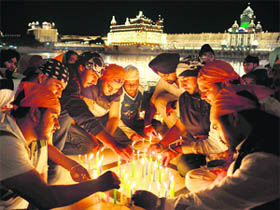
| Devotees light candles on the occasion of the 542nd birth anniversary of Guru Nanak Dev at the Golden Temple in Amritsar on Thursday. |
November 10, 2011
Dispelling the mist of spiritual ignorance

November 9, 2011
Toronto is Canada’s least-liked city, survey says

But there's something we all seem to agree on: We don't like Toronto.
That perception is bolstered by a new survey conducted by Leger Marketing for the National Capital Commission and the Association of Canadian Studies.
The National Post reports Canada's biggest city is also the most disliked. It had the highest rate of "very negative" responses in the survey.
"Many Canadians have a hate-on for Toronto," Myer Siemiatycki, a Ryerson University politics professor, told the Post. "Toronto is regarded as totally self-indulgent, so there's a sort of 'Who do they think they are believing they're the centre of the country and the universe?' "
The perception seems to have little to do with any actual experience with the city or loyalty to people's home towns.
"It's not necessarily that people like their city more than Toronto," said Jim Milway, executive director of the Martin Prosperity Institute at the Rotman School of Management. "It's that people just don't like Toronto, period."
The poor opinion is greatest in Quebec, Alberta and British Columbia, places Siemiatycki says have the most pride in their own cities. Thirty per cent of Albertans are poorly disposed to Toronto, with a Canadian average of 19 per cent.
"The places with the strongest sense of their own vitality and robustness are the ones who are the most put off by Toronto,". Siemiatycki says. "It's no coincidence that it's the three other largest provinces, with Canada's other most dynamic cities — Montreal, Vancouver, Edmonton, Calgary — that look askance and say, 'We're the hotspot, dynamic urban place.' "
The survey also suggests Quebecers are the most insular Canadians, posting the highest percentage of "don't know" responses to questions on how they perceived cities outside their province. They were least familiar with Victoria and Halifax.
"It seems to me that they're not in a position to make an evaluation because they haven't been there," Jack Jedwab, executive director at the Association for Canadian Studies, told the Post. "They seem to be the least well-traveled."
Speaking of Victoria, it got the most love, with 39 per cent of respondents saying they had a very positive perception of the B.C. capital.
Michaelle Jean's prestigious new job
Michaelle Jean named as the University of Ottawa’s new chancellor
The former governor general will take on another important post in the nation's capital.
Michaelle Jean will assume yet another prestigious post in our nation's capital, as the former governor general has been named the University of Ottawa's new chancellor. 'I'm very excited about this' She says.
A chancellor, appointed by the board of governors and approved by the senate, serves as the titular head of the university. The post lasts four years, but is eligible for re-election.
Jean, who is also a UNESCO special envoy for Haiti, will replace outgoing chancellor Huguette Labelle.
"I'm very excited about this appointment… for the trust they have placed in me," said Jean, referring to the board and senate. As the Ottawa Citizen reports, she also reached out to university staff and faculty, saying she was "thrilled to be to reflect their goals and achievements."
Robert Giroux, president of the board of governors, said the 54-year-old's progressive values were a good fit for the university's forward-thinking direction.
"The unifying values championed by Ms. Jean fully match our university's desire for a healthy academic environment, open to the world and looking towards the future," he said.
The position marks another notable achievement in the former journalist's life.
Born in Haiti, Jean's family fled to Canada as political refugees from President Francois Duvalier's violent regime.
Her family settled in Quebec, where the young Jean excelled as a student. She studied comparative literature at the Universite de Montreal, eventually teaching in the school's department of modern languages and literature.
In addition to her academic work, Jean helped establish a network of shelters across Canada for female victims of domestic violence.
As a journalist, Jean reported and produced for Radio-Canada before joining CBC Newsworld as host of The Passionate Eye and Rough Cuts. She made several films with husband, Jean-Daniel Lafonde, including the award-winning Haiti dans tous nos reves (Haiti in all our dreams).
Jean became the 27th Governor General of Canada in 2005 when she was appointed by Queen Elizabeth II on the recommendation then-Prime Minister Paul Martin. She held the position until 2010 and was succeeded by David Johnston.
She replaces Huguette Labelle, who held the position for 17 years, and oversaw the university's growth from 18,000 students in 1994 to more than 40,000 enrolled today.
Jean will begin her post on February 1, 2012.
UK Immigration arrests Garry Sandhu
Award winning, Bhangra singer, Garry Sandhu was taken into custody on 27th October 2011 by the UK Border Agency for not fulfilling his right to stay in the UK. Implying that the singer was here on an illegal basis.

 The singer recently performed live at the Brit Asia Awards 2011 at Hammersmith Apollo and at many melas in the UK, including the London Mela. His songs like ‘Sahan To Pyariya’ and ‘Tohar’ recieved a tremendous response. In a recent interview, he said he worked as a brick layer and builder, and decided to pursue a singing career because of the response of his fans and huge ethnic media support such as from Raaj FM, BBC Asian Network and Brit Asia.
 Prior to ‘Main Ni Peenda’ he did attempt a track with music producer Jeeti which was a version of ‘Dil De Deh’ which was not released but was subsequently, re-produced in collaboration with Roachkilla. DJH produced ‘Sahan To Pyariya’ which was a huge hit for Sandhu.
"if someone says are you a freshie, I say yes I'm freshie, so what?"
Garry Sandhu, the Brit-Asia award winning singer has been arrested by the UK Border Agency for violating UK immigrations laws. It is revealed that he has not honoured his status to leave the country on a voluntary basis after not having the right to stay in the UK.
Gurmukh Singh Sandhu (Garry Sandhu), the winner of the Best Newcomer and Best Male Act at the recent Brit Asia Awards 2011, was arrested and taken into custody on 27th October 2011.
Ironically, his latest song and video called ‘Fresh’ was based on being a ‘Freshie’ and ‘foji’ which relates to a person who is ‘fresh of the boat’ from India, Punjab. The news of him being an illegal immigrant indicates how close he to the subject matter of the song.
This news will be a shock to the Asian music industry and his fans who saw Garry Sandhu as a new rising star on the scene.
DESIblitz.com can fully confirm the arrest after receiving an email statement from the UK Border Agency. Toby Allanson from the UK Border Agency in the statement said:
“We can confirm an Indian national was detained yesterday in the West Midlands area. When someone is found not to have a right to remain in the UK, we expect them to leave voluntarily. If they fail to do so, we will seek to enforce their removal.”
The singer recently performed live at the Brit Asia Awards 2011 at Hammersmith Apollo and at many melas in the UK, including the London Mela. His songs like ‘Sahan To Pyariya’ and ‘Tohar’ recieved a tremendous response. In a recent interview, he said he worked as a brick layer and builder, and decided to pursue a singing career because of the response of his fans and huge ethnic media support such as from Raaj FM, BBC Asian Network and Brit Asia.It’s evident from the arrest that Garry was not here in the UK on legitimate terms and if proven, the chances are he will be deported back to India. Gary was living and working in Handsworth, a very ethnically rich area of Birmingham.
Garry started his music career in the UK after he was given support by Jas Sandhu who gave him work in catering initially and and then subsequently, became his manager. Garry was introduced to Pamma Sohal by Jas who helped him record and release his first song and music video with music producer Kam Frantic, called ‘Main Ni Peenda’ which brought him attention as a Punjabi singer.
Prior to ‘Main Ni Peenda’ he did attempt a track with music producer Jeeti which was a version of ‘Dil De Deh’ which was not released but was subsequently, re-produced in collaboration with Roachkilla. DJH produced ‘Sahan To Pyariya’ which was a huge hit for Sandhu.Garry an avid user of Facebook with over 14,000 fans of his page, appeared on many television shows, on numerous interviews and features on a dedicated YouTube channel. Therefore, he was very much in the public eye and performed at many events and functions up and down the country.
Garry openly proud of being a ‘freshie’ himself said:”Proud to be freshie. Okay I’m a freshie but if some one says it behind my back then it hurts me, if someone says are you a freshie, I say yes I’m freshie, so what?”
Therefore, many people will wonder how can an artist like this present himself openly in the manner but also be an illegal immigrant at the same time? This is a question amongst many others that will need answers from Garry, especially for fans of his music who have given him trust, love and support for him as a person and a singer.
Soaring rate of British Asian Divorce
Divorce was once taboo in British Asian communities. Today, it is one of the most highly growing social problems affecting these communities and seems to be taking place very early in Brit-Asian marriages, completely changing the landscape of Brit-Asian life compared to older generations.

 Divorce in South Asian society was once a very taboo subject and very seldom heard of, even in the UK. Older Asian generations that migrated to the UK, got married at a young age, usually in the form of arranged marriages and had children very soon after. The nucleus of the home was the family and subsequently, the extended family. Mothers usually stayed at home looking after and bringing up children and the father was seen as the head of the household and usually the income provider. A framework that defined roles, responsibilities and the foundation to the relationship of a migrant couple.
 No longer were many Brit-Asian men and women thinking in the same way as their grandparents or parents. They felt part of mainstream British society much more comfortably than previous generations. This led to marriage not becoming the priority in their lives because careers, business and status took centre stage. The era of professional Brit-Asians was upon us.
 These changes have impacted family life, breaking the nucleus that was once prominent in Asian households. Brit-Asian marriages were primarily seen as the uniting of families rather than just two people and were strongly held together through guidance and support from families. However, marriages today, are more the unity of the couple rather than the families.
 British Asian marriages are collapsing at an alarming rate. Many within the first year of marriage and often include couples that have dated for a long period prior to marriage too.
 Brit-Asian divorces are generally breaking families into an ethnic society of single parent mothers and isolated fathers. Children are growing up with disjointed parenting and atmospheres of bitterness and hatred amongst their parents. Which raises the question of the emotional stability and respect within future relationships of the children too.
 Baldish Khatkar, another lawyer with Brit-Asian divorce expertise, says that it’s not only younger couples that are divorcing. She comes across some older couples who have been married 20 or 30 years who no longer want to continue with their relationships.
marriages today, are more the unity of the couple rather than the families
On a Sunday afternoon, a British Asian man waits in a car and you see two young children in the back seats. A few moments later a British Asian woman walks up and stands a distance away from the car. It completely appears that the woman has nothing to do with the people in the car and that she is waiting for someone. Both adults look in their late 20s or early 30s.
Sometime later, one child, a boy, comes out of the car and runs up to the woman. She greets the child hugging and kissing him. Then, the man gets out and releases the second child, a girl, out of its child-seat. He passes her belongings to her. The little girl hugs the man tightly and then walks up to the woman. The man gets back into his car and drives off. There is coldness, bitterness and absolutely no communication between the adults.
This scene is from Birmingham city centre in the UK with real people. This scene is the visualisation of a divorced British Asian couple with young children. This scene is a reflection of British Asian parenting and society today.
Divorce amongst British Asian couples is soaring. And there does not seem to be a fix to the problem in sight.
Has it become too easy for British Asian couples to divorce? Have British Asians in particular given up on making relationships work? Has tolerance in couples and expectations overridden cultural values and impact on future generations? What is the real cause of British Asian divorce? These are questions being asked of today’s British Asian society.
Divorce in South Asian society was once a very taboo subject and very seldom heard of, even in the UK. Older Asian generations that migrated to the UK, got married at a young age, usually in the form of arranged marriages and had children very soon after. The nucleus of the home was the family and subsequently, the extended family. Mothers usually stayed at home looking after and bringing up children and the father was seen as the head of the household and usually the income provider. A framework that defined roles, responsibilities and the foundation to the relationship of a migrant couple.As generations developed and got educated, British Asian society began to take advantage of what British life, work and leisure had to offer. In the early 1970′s to 80′s more first generation Brit-Asian men went to University and Polytechnics compared to women. Young women were still seen as home-makers, and education was not an option for many due to family suppression. However, in the 1980′s to 90′s this began to change, more young Brit-Asian women attended higher education and pursued professional careers like the men.
Some cultures within ethnic communities were still not happy about women getting educated. So, you saw more Indian students than Pakistani students for example. However, this shift in education also introduced more freedom and liberalisation in the next generations of British Asians.
No longer were many Brit-Asian men and women thinking in the same way as their grandparents or parents. They felt part of mainstream British society much more comfortably than previous generations. This led to marriage not becoming the priority in their lives because careers, business and status took centre stage. The era of professional Brit-Asians was upon us.The trend in arranged marriages declined and the concept of meeting your own partners began to grow. Bringing us to the point where British Asian marriages are a mix of love, arranged and even speed dating encounters. Brit-Asian women have evolved to being financially and professionally secure, whilst British Asian men have thrived in all kinds of business and professional life, no longer stereo-typed as corner-shop owners.
Young Brit-Asian married couples are more commonly living independently from family. The notion of the extended family is eroding. Educated daughter-in-laws find it difficult to adapt to the traditional demands by in-laws and in return in-laws find it hard to understand new ways and accept change causing conflict and differences in opinion.
These changes have impacted family life, breaking the nucleus that was once prominent in Asian households. Brit-Asian marriages were primarily seen as the uniting of families rather than just two people and were strongly held together through guidance and support from families. However, marriages today, are more the unity of the couple rather than the families.Marriage is always seen as a key milestone in Brit-Asian life. A UK National Statistics report says the highest proportions of married couples under pension age, with or without children, are were in Asian households. Over half of Bangladeshi (54%), Indian (53%) and Pakistani (51%) households contained a married couple, compared with 37% of those headed by a White British person. Demonstrating the importance of marriage for the Brit-Asian communities.
Lifestyle choices of British Asians have led to marriages happening later in life. Implying that you are more prepared for marriage when you feel you are ready compared to when your parents and family think you are ready. Giving more time and choice towards finding the ‘right’ person. Hence, the popularity of dating is now more common in British Asians compared to the past.
This shift in the British Asian marital process has definitely provided more choice and less pressure for many but at the same time it has led to divorce happening more frequently too. Elder generations say it is due to the dating and more choice, that young British Asian couples find it harder to stay together, because some may compare partners to previous relationships, other have high expectations of their partners, many are too selfish in the relationship and lots are not prepared to work at the marriage because they know they can divorce easily.
British Asian marriages are collapsing at an alarming rate. Many within the first year of marriage and often include couples that have dated for a long period prior to marriage too.Reasons for marriage break-up include boredom, lack of interest in a partner, in-law pressures, limited time for each other, imbalance in giving and taking, intolerance of each other, money and work pressures, arranged marriages and extra-marital affairs.
Affairs and adultery incidents have risen dramatically amongst British Asians which include not only high rates in men but women too.
Many blame the advent of mobile phone culture, social networking, Internet dating and chat, making it very easy to meet new people. For many exposure to members of the opposite sex using these methods introduces thrill, excitement and attention missing in their marriages. Also, giving them secrecy and anonymity as required.
Brit-Asian divorces are generally breaking families into an ethnic society of single parent mothers and isolated fathers. Children are growing up with disjointed parenting and atmospheres of bitterness and hatred amongst their parents. Which raises the question of the emotional stability and respect within future relationships of the children too.Family divorce lawyer, Irpreet Khoil reveals that changes in parental attitudes towards divorce are also changing, and that parents are more prepared to accept their successful son or daughter wishing to divorce, who otherwise would’ve been told to stay in the marriage for the sake of ‘izzat’ (family honour).
Baldish Khatkar, another lawyer with Brit-Asian divorce expertise, says that it’s not only younger couples that are divorcing. She comes across some older couples who have been married 20 or 30 years who no longer want to continue with their relationships.Many would therefore argue that much has been lost and very little has been gained by the new British Asian culture. And question, whether divorce is the ideal solution for Brit-Asian couples who after dating, courting and living together still cannot achieve harmony in a marriage compared to older generations who kept it together through tougher times and getting married in some cases after only meeting once.
And yes, its not only happening here in the UK. In India divorce is rising significantly amongst the urban middle class in city areas. Dr Geetanjali Sharma, a marriage counsellor from Delhi told the BBC: “There’s been a 100% increase in divorce rates in the past five years alone.”
What would you say are the reasons for Brit-Asians divorcing? Do you agree it is too easy to divorce nowadays? Is divorce the best answer to a marriage that may need more time?
Courtesy: Desi Blitz
Subscribe to:
Posts (Atom)