News, Views and Information about NRIs.

A NRI Sabha of Canada's trusted source of News & Views for NRIs around the World.


November 5, 2011

Special Sikh pilgrimage train in January

Chandigarh, November 5
The Indian Railway Catering and Tourism Corporation (IRCTC) is all set to launch a nine-day special Sikh pilgrimage train in January next year. The train would be covering the five Takhts (temporal seats) of the Sikhs.

The train is being launched by the IRCTC in association with the Punjab Heritage and Tourism Promotion Board (PHTPB) to woo Sikhs living across the globe who aspire to visit the historic five Takhts.
IRCTC's Chief Regional Manager RK Sondh said the train would start from Amritsar and would take the devotees to Anandpur Sahib, Takht Damdama Sahib at Talwandi Sabo in Bathinda District, Hazoor Sahib, Nanded in Maharashtra, and Patna Sahib in Bihar.
It is to be mentioned that the people of Punjab have been demanding a train to connect the historical Takhts. Chief Minister Parkash Singh Badal had sent a proposal to the Union government a few years ago for a similar trip and even deposited the state's share, but the Centre did not respond.
Sondh said the nine-day tour had been specially designed to woo the Sikhs living abroad and who visit the country during winters and aspired to visit their religious places. “The tour will offer free meals, accommodation and other facilities during the trip. The passengers will also be insured during the trip,” he added.
He said the fully air-conditioned train would have first AC, II-Tier AC and III-tier AC and the passengers would be taken in air-conditioned buses to all religious places from the respective railway stations. He said dates were being finalised with officials of the PHTPB and hoped that train would be a success. He said boarding and lodging would be provided by the IRCTC.

Greek prime minister set to form new government


Greek Prime Minister George Papandreou said Saturday he will do what it takes to form a coalition government and push through a controversial international bailout package.
He met the country's president Saturday to ask permission to form a coalition, hours after winning a vote of confidence by a narrow margin, and has begun talks with smaller parties on forming a government.
The vote gives his country's stricken economy some breathing room -- and may reassure international markets sent into a tailspin by this week's political turmoil in Greece -- but many questions remain unanswered.
The 153-145 confidence vote victory came minutes after Papandreou announced that he would seek a coalition government, but it was not immediately clear who would lead it.
Reports have named current Finance Minister Evangelos Venizelos as a possible successor as caretaker prime minister.
Venizelos said Friday night he wanted to see a temporary three-month government that would push through all the necessary legislation through February. Elections would be likely to follow.
Speaking briefly after his meeting with President Karolos Papoulias, Papandreou said he would take the necessary actions to form a wider cooperation government.
He said implementing a controversial bailout package agreed October 26 was a priority, to ensure Greece stayed in the euro, the single currency used by the 17 nations in the euro zone.
European leaders warned this week that although they wanted Greece to stay in the euro, they considered saving the currency more important, amid fears that the Greek crisis could spread to other European countries and beyond.
In forming Greece's new government, Papandreou's Socialist PASOK party is likely to seek the support of a number of smaller parties, on either the left or the right, after the main opposition leader Antonis Samaras made it clear he did not want to be part of a coalition.
Samaras has called for a transitional government for six weeks, followed by elections.
Papandreou argued it would be disastrous if elections were to be held immediately, because that would leave the latest bailout deal "up in the air."
The deal would wipe out 100 billion euros in Greek debt, half of what it owes. It comes with a promise of 30 billion euros from the public sector to help pay off some of the remaining debts, making the whole deal worth 130 billion euros (U.S. $178 billion).
But the package comes with strings that would require Greece to slash government jobs, privatize some businesses and reduce pensions.
Antonis Papagiannidis, editor of Greece's Economic Review, told CNN such austerity measures ran the risk of deepening Greece's recession.
Meanwhile, Greece's fierce party politics mean it is difficult to know what will come next following the confidence vote, he said.
"Everybody is a little confused, while at the same time the clock of the markets is ticking, tick tock," he said. "Some sort of all-out disaster is still looming right round the corner."
Papandreou's narrow victory Saturday is expected to mean that Greece will get its next tranche of money from a separate international agreement brokered in May 2010, allowing it to pay its bills next month and avoid immediate default.
That $8 billion euro payment had been threatened when Papandreou announced earlier this week that he would take the bailout package to the Greek people through a national referendum, a move he retracted Thursday.
He came under enormous pressure from international leaders, many of whom were meeting for the G-20 summit in Cannes, France, to act to restore stability in Greece.
Though Greece ranks 32nd in terms of gross domestic product, experts say it wields a disproportionate influence on world markets; economists fret that a Greek default could drag down larger European economies, in particular those of Italy and Spain, as well as struggling Portugal and Ireland.
Although Italy's finances are in much better shape than those of Greece, it has a huge pile of debt and borrowing costs for the Italian government rose to a euro-area high of 6.43% Friday.
Tens of thousands of opposition party demonstrators turned out in central Rome Saturday to voice their opposition to the government of Italian Prime Minister Silvio Berlusconi, after he said Italy had agreed to let the International Monetary Fund "certify" its reform program, a step designed to boost investor confidence.
But he faces a vote of confidence as soon as next week amid criticism of his handling of Italy's economy -- and analysts say he may no longer have the support of a majority in parliament.
A crucial vote on budget reform measures is expected in Rome on Tuesday.
During the hours of debate ahead of the confidence vote in Athens, Papandreou reiterated an appeal for approval of the international bailout package that the country has been offered, calling it "a huge chance, and perhaps the last one, to rebuild a country with new and strong foundations."
Papandreou insisted that he has no great desire to maintain his grip on power.
"The last thing I care for is the chair," he said. "I don't care if I never get elected again."
He defended his leadership, accusing previous governments of miring the Greek economy in debt. "Those days, you could borrow money easily, and now that's why the Greek people have to pay back for it," he said.
Papandreou said he now wanted "to turn the page over and move forward."
Under a motion of confidence, lawmakers signal to the head of state whether the government has the support of parliament. A loss typically results in the government's dissolution and the holding of a general election unless the head of state asks someone with more support to form a government.
"It's not over," said Heather Conley, director of the Center for Strategic International Studies' Europe Program, about the Greek crisis. "We're buying time in nearly daily increments. It doesn't change the fact that this is a fourth year of a Greek recession, and they have missed nearly all their austerity targets."
The real solution would be to redefine the euro zone and the European Union, creating a transfer of wealth from north to south, she said, adding "That's not going to happen."
Meanwhile, the country is pursuing two strategies -- trying to buy time to fix its economy and trying to prevent contagion.
U.S. President Barack Obama told the G-20 summit Friday he was confident that Europe could meet the challenge presented by the troubled global economy.
"Make no mistake, there is more hard work ahead and more difficult changes to make but our European partners have laid a foundation on which to build," Obama said.

Greeks feel anger, humiliation


Athens, Greece - What a difference a day can make. It's saturday and Greek Prime Minister George Papandreou has survived the midnight confidence vote, seen President Karolos Papoulias and is now going about forming a coalition government with a few smaller parties.
Does it matter who forms a coalition government?  Not really. The bottom line is that whoever is the next Prime Minister - and my money is on Finance Minister Evangelos Venizelos – s/he will still have to cobble together a majority of the 300-member parliament to do one thing and one thing only: pass the massive austerity package agreed in Brussels on 27 October. It’s that simple.
The Greeks don’t like the pain and austerity that has been imposed on them by their own government in return for massive loans from the IMF and the European Union. But there is really no choice. Sure, the opposition party, New Democracy, has promised less pain - but don’t parties out of power always promise that? Anyway, the word on the street in Athens is that New Democracy will not be a part of any coalition government.
Venizelos said Friday night he wanted to see a temporary three-month government that would push through all the necessary legislation by February. After that, I suspect, would follow elections.
The hope here is that it will buy enough time to keep markets calm, get the massive October program implemented across Europe and let people focus on the next hot spot: Italy.
So, what do people in Athens think of all this? Those I have spoken to have summed it up in a few words: confusion, anger and humiliation.
The confusion came when the PM said he wanted the Greek people to vote in a referendum on the latest bailout agreement. I sense he made that decision out of anger and frustration, that the he was not cheered in Athens for the deal he struck. But now the referendum is dead, to the delight of the rest of Europe. After all, what if the Greek people voted no to austerity to punish Papandreou? EU leaders said that could mean the end of Greece in the euro.
The anger has not been the anger of violent protests: we have seen well organized and peaceful marches this week. Rather it has been directed at all of Greece's main political parties, who are jointly held responsible for a decade of mismanagement. Noone here believes that there is a political savior waiting in the wings.
There are many news channels in Greece and numerous newspapers – extraordinary for a country of only eight million - and the Greeks note with great interest that the international media is once again back in Athens.  State broadcaster ERT is showing video of my reports and CNN anchors, as well as the BBC and Sky. Last night, nearly every balcony in our hotel featured a foreign broadcaster with a portable satellite dish, using the Greek parliament building opposite as a backdrop.
The nitty gritty of Greek politics is not, in the longer term, crucial to the bigger storm surrounding the European crisis. But the Greek media is very aware of how the country is perceived by the rest of the world. And that’s where the humiliation comes in. As one woman on the street told me: “Please don’t say the Greek people are lazy, we are not.” Instead she blames Greek politicians of all stripes.
I suspect most Greeks would back what their PM said Friday night:  “We have to move from a Greece of deficits and move on to a Greece of credibility.”

FARC leader dies in Colombian military operation


The leader of Colombia's main leftist rebel group -- the Revolutionary Armed Forces of Colombia -- died in a military operation in the country's southwest, President Juan Manuel Santos said Saturday.
" I confirm the death of Alfonso Cano. The No. 1 of FARC is dead," Santos said. "This is the most overwhelming blow given to the FARC in all of Colombia's history."
The military operation that took place Friday in the state of Cauca also killed Cano's communications chief, a female friend and members of his security team, Defense Minister Juan Carlos Pinzon told reporters. Cano's chief of security was captured.
"The death of Alfonso Cano is the most important historical mark of our military forces and our national police in our fight against the FARC organization," Pinzon said. "He was part of the organization for over 33 years. He was their ideologue, their political figure and most importantly, he was a despised terrorist ready to act in a radical way ..."
Cano, an alias for Guillermo Leon Saenz, took over the FARC's top spot in March 2008 after an apparent heart attack killed the former leader, Manuel Marulanda.
"This is great news for all the Colombian people," said Labor Minister Rafael Pardo. "This will help the peace process and it shows that armed conflict is no longer the way forward in Colombia."
The FARC has been at war with the Colombian government since the 1960s. While severely weakened in recent years, the guerrilla group has continued to carry out kidnappings and attack security forces in the South American nation.
The United States and European Union consider the FARC a terrorist organization.
In July, Santos said Cano escaped an attack by less than a day. At the time, security forces raided a remote camp believed to have been his hideout.
After the raid, authorities found clothes they believe belonged to Cano.
CNN affiliate Caracol TV reported that authorities also found large quantities of the cigarettes the FARC leader is thought to smoke.
"We were very close," the president told reporters at a military airport in Bogota.
He said security forces had acted on an intelligence tip from one of Cano's "own people."

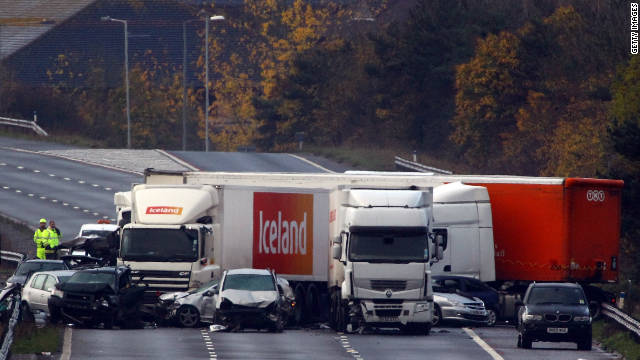
7 killed, 51 injured in UK traffic pileup


London (CNN) -- At least seven people are confirmed dead and 51 injured in a "horrific" traffic accident in southwest England, Somerset police said Saturday.
The accident involved 34 vehicles, including cars, vans and large trucks, police said, some of which erupted into a "fireball."
Assistant Chief Constable Anthony Bangham told reporters more bodies are feared to be still trapped in badly burnt vehicles.
Some of the vehicles are "burnt to the ground" and unrecognizable, he said in a televised news conference after visiting the site. "This is a horrific scene."
The crash occurred about 8:25 p.m. Friday on the M5 highway near Taunton in Somerset, about 70 kilometers (45 miles) southwest of Bristol, according to the Devon and Somerset Fire Rescue.
Bangham said poor weather was likely to have been a factor, with wet roads after rain and banks of fog reported in the area.
Police were also looking into a nearby fireworks display to see if it may have played a role, he said.
He praised members of the public who showed "real bravery" in trying to rescue people from blazing vehicles, as well as the efforts of the emergency services.
"For a motorway incident, this is just about as big as it gets," he said. "This is a highly complex, very dramatic incident for our officers."
He said part of the highway would remain closed in both directions until at least Sunday.
About 15 fire trucks were sent to the scene, as rescue workers battled to extinguish blazing vehicles and cut free trapped passengers.
Avon and Somerset Police have appealed for anyone who witnessed the events to get in touch, especially if they have mobile phone footage.