News, Views and Information about NRIs.

A NRI Sabha of Canada's trusted source of News & Views for NRIs around the World.


January 24, 2012

Harper shrewdly dodges big issues, grand vision at First Nations meeting


Canada's Prime Minister Stephen Harper (C) looks on as Assembly of First Nations Chief Shawn Atleo (L) takes part in a traditional smudging ceremony at the Crown-First Nations Gathering in Ottawa.

Canada's Prime Minister Stephen Harper (C) looks on as Assembly of First Nations Chief Shawn Atleo (L) takes part in a traditional smudging ceremony at the Crown-First Nations Gathering in Ottawa.


OTTAWA — Ovide Mercredi didn't like the word "incremental." When it came his turn to speak at Tuesday's aboriginal conference in Ottawa, the former national chief of the Assembly of First Nations tartly noted that "to us, the answer is not about incremental change."
It was a not-so-subtle dig at Prime Minister Stephen Harper, who just a few minutes earlier had offered precisely that. After ruling out a holus-bolus scrapping of the Indian Act, Harper promised "creative ways, collaborative ways, ways that involve consultation between our government, the provinces, and First Nations leadership and communities . . . ways that provide options within the (Indian) Act, or outside of it, for practical, incremental and real change."
Phew. A mouthful. But it encapsulates in a few short lines the Harper government's strategy for addressing the endemic misery and suffering engendered by the reserve system. Here's a bet: Harper will get hammered, in the days to come, by those who believe he should have outlined a grand vision, or at least a few bold measures. But the PM may be crazy like a fox here.
Does the Indian Act have to go? Absolutely. This relic of 1876 (though it has undergone "updates" since the original) is unabashedly, explicitly racist. It is an abomination, in fact. And no one can credibly deny that the system it underpins perpetuates misery. Consider the numbers, all of which have been reported before, by me among others. They bear repeating.
In 2000, the rate of aboriginal mortality was twice that among non-aboriginals. In 2004, aboriginal Canadians were twice as likely as non-natives to be a repeat victim of crime, and nearly four times as likely to be the victim of spousal violence. Even within the aboriginal population there is great disparity in quality of life, based on whether an individual lives on reserve or off. In 2004, violent crimes reported by aboriginals living off-reserve registered at 953 per 100,000. For residents of reserves the number was nearly seven times higher, a staggering 7,108 per 100,000 people.
The current national chief of the Assembly of First Nations, Shawn Atleo, has made no secret of his revulsion for the Indian Act and for the system in general. Indeed last summer he called for the Act to be abolished, along with the federal Department of Aboriginal Affairs.
So, why would Harper not have been bolder?
In avoiding the grand gesture, in my view, Harper dodged a bullet. For had he made a sweeping pledge to abolish the Indian Act, rather that work within and around it as he did, he'd have roused suspicion and anger from at least some band chiefs, of whom there are about 600 across Canada (about 400 attended the meeting in Ottawa). They would have charged that he intended to reboot Jean Chretien's White Paper of 1969.
The White Paper, in keeping with Pierre Trudeau's Just Society, proposed that the Indian Act and the reserves be done away with so that all Canadians could be equal under the law. It was shelved due to opposition from the chiefs. The White Paper is remembered and reviled by many aboriginal leaders today as having been assimilationist and paternalistic. It's one thing for Atleo to say the Indian Act should be scrapped. It would be viewed as another entirely, within the aboriginal community, for Harper to do so.
Likewise Harper avoided the charged topic of private property. He touched a lot on economics, ("it is therefore in all of our interests to see aboriginal people educated, skilled and employed,") and did so in expressly conservative terms ("our goal is self-sufficient citizens and self-governing communities.") But he dodged the biggest economic issue of all, which is that most aboriginals living on reserve are deprived of the Canadian middle class's basic tool for creating wealth — building equity in a home.
Here again, Harper was probably wise to leave this alone, for now — because the pressure for greater access to private property is already bubbling up from within the native community, with reformers such as Chief Manny Jules, chief commissioner of the First Nations Tax Commission, leading the way. Had Harper pushed for it from his bully pulpit as prime minister, he would simply have coalesced opposition.
What's emerging is an oddly Canadian-libertarian approach to social reform: Put the principals in a room, listen, establish some basic ground rules (on the health-care file the rules were budgetary), then back off and let them find their own solutions. At the very least it avoids the suggestion that Ottawa is being a bully.
If it works in native affairs, even modestly, the potential political payoff for Harper is significant. For starters, it would establish that he has objectives that extend beyond minding the store. And it would raise his stock in centrist, vote-rich Ontario — still the key to his winning a second majority.

Harper calls for more 'modern' Indian Act

OTTAWA — Prime Minister Stephen Harper and National Chief Shawn Atleo both spoke of a renewed relationship Tuesday at the Crown-First Nations Gathering in Ottawa.
But when it came to specifics, the two leaders were slightly — maybe even completely — at odds. Harper said his government has no plans to repeal or rewrite the Indian Act, but Atleo said it is a painful obstacle to re-establishing any form of meaningful relationship.
Still, at the end of daylong meetings, which included 150 chiefs and 12 cabinet ministers, most chiefs said they were heartened by the dialogue and called the event an important first step.
Harper, who was expected to leave after the opening ceremonies, ended up staying through the day — a move Lake Huron Regional Grand Chief Isadore Day said showed "he was listening."
Day was part of a delegation of 30 chiefs who met with the prime minister Monday evening in an impromptu closed-door session on Parliament Hill.
"Last night had just as much, if not more, significance than today," said Bill Erasmus, Regional Chief of the Northwest Territories. "The prime minister heard directly from the leaders."
As for Tuesday's meetings, Nishnawbe Aski Nation Grand Chief Stan Beardy said "a lot of beautiful words were spoken, but in terms of addressing the immediate needs of my people, there was nothing."
Atleo, National Chief of the Assembly of First Nations, expected the skepticism felt both by First Nations communities and all Canadians. In his opening speech, he said "the proof of our commitment will begin tomorrow, and in the weeks and months ahead, demonstrating that this time, this generation of leaders, will not fail to make the changes we all know are urgently needed."
He said the meeting was an important step in rebuilding a broken trust, and in renewing the partnership in the image of the first partnerships, which were built upon formal treaties entered into by two equal nations.
Harper said that co-operation on numerous levels is necessary to fully bring Canada's First Nations into the country's economy.
He said his government's approach will be to "replace elements of the Indian Act with more modern legislation and procedures, in partnership with provinces and First Nations."
Pam Palmater, a Mi'kmaq lawyer and commentator, said Atleo and Harper were speaking two different languages, and they had two different plans. She called Harper's plan of educating young aboriginals to bring them into the workforce "assimilationist," saying it would break up communities and take First Nations in the same direction they've been going for years.
Atleo, on the other hand, spoke about self-determination, getting back to treaty relationships and preserving First Nations communities, said Palmater. "There is no common understanding," she said.
Grand Chief Derek Nepinak of the Assembly of Manitoba Chiefs said he was concerned the meeting hadn't yielded any promises from the government. "We're living in crisis right now in Manitoba, and I'm going home to that."
The prime minister called this meeting in early December in the midst of a dire housing crisis on Attawapiskat First Nation, as images flowed out of the remote James Bay reserve of children and the elderly living in shacks, without access to running water or toilets. Most of the community survives on welfare and, since the crisis, other chiefs have come forward saying their people face many of the same challenges.
"We need only to look to Attawapiskat, Marten Falls, Pikangikum, and St. Theresa Point — among dozen of other communities, on reserve and in our cities, to see the impact of broken promises, the pain of broken lives, the tragedy of lost opportunity," said Atleo in his speech. "Our people cannot wait."
For his part, Nepinak said he was hoping the government would announce a meeting with First Ministers and First Nations to talk about resource sharing. He would have been happy, he said, to hear the government promise to lift the two per cent funding cap on education, which was imposed in 1996.
Many chiefs said they had wanted to hear promises about a renewed treaty relationship, whereby First Nations would gain control over the natural resources on their territories and become part of the development process with the federal and provincial governments.
"We came here expecting a dialogue about our treaties. Instead I heard they want to train our young people to have jobs — to work for someone else," said Beardy.

Most to least affordable housing in Canada (cities over 1,000,000 population)

Gallery: Most to least affordable housing in Canada (cities over 1,000,000 population)

Indian PM joins Twitter


NEW DELHI: Prime Minister Manmohan Singh has joined Twitter to capture the attention of young Indians and inform people about the work done by his office through 140 characters on the microblogging site.

"The Prime Minister's office is now on Twitter @PMOIndia Thank you for your support," Manmohan Singh's newly appointed communications advisor Pankaj Pachauri said on his own Twitter account.

Within hours of opening the account late Monday, Manmohan Singh had attracted nearly 7,000 followers and written three tweets till Tuesday afternoon.

The account refers to the Prime Minister's Office (PMO) and it would be handled by his media team, PMO sources said.

The prime minister's opponents have been criticising him for maintaining silence over burning issues and remaining inaccessible to the media.

A close aide told IANS that the work done by his office was not being "reflected properly". "The Twitter account may help in sending out the information to larger, particularly young, audiences."

His first three tweets were about a function on bravery awards. This included his picture with the winners.

"You make all of us proud...PM tells young bravehearts," said his last tweet, which provided a link to his public speech at the bravery awards function.

PMO sources said the account was presently managed by his communication team but there was a possibility that Manmohan Singh would send out tweets personally.

The account has already invited a barrage of reactions from people. "The #PMOIndia twitter account is a brilliant attempt to tweet silence in 140 characters," said @RoflIndian.

WikiLeaks’ Julian Assange to launch talk show in March

Wikileaks Founder Julian Assange 
LONDON – WikiLeaks founder Julian Assange said Tuesday he was launching his own television talk show, promising interviews with “key political players, thinkers and revolutionaries.”
No guests were unveiled, but a statement on the WikiLeaks website said the show would go on air in mid-March in 10 weekly half-hour episodes.
The show promises to feature “controversial voices from across the political spectrum – iconoclasts, visionaries and power insiders – each to offer a window on the world tomorrow and their ideas on how to secure a brighter future.”

Describing Mr. Assange as “one of the world’s most recognisable revolutionary figures,” the whistleblowing website said it had licensing commitments covering more than 600 million viewers across cable, satellite and terrestrial networks.
The statement gives no detail on which channels have bought the show and directed questions to a company called Quick Roll Productions, which was not immediately available for comment.
Mr. Assange said: “Through this series I will explore the possibilities for our future in conversations with those who are shaping it. Are we heading towards utopia or dystopia and how we can set our paths?
“This is an exciting opportunity to discuss the vision of my guests in a new style of show that examines their philosophies and struggles in a deeper and clearer way than has been done before.”
WikiLeaks enraged the U.S. administration by releasing tens of thousands of confidential documents about the wars in Iraq and Afghanistan, and then a ‘dump’ of files revealing the thoughts of U.S. diplomats on world leaders.
Mr. Assange, a 40-year-old Australian former computer hacker, is fighting extradition from Britain to Sweden where prosecutors want to question him over allegations that he raped and sexually abused two Swedish women.
England’s highest court will next week hear Mr. Assange’s appeal against his extradition.
If the Supreme Court rejects his case in the February 1 to 2 hearing, he will have exhausted all his options in Britain but he could still make a last-ditch appeal to the European Court of Human Rights.
Mr. Assange insists the allegations are politically motivated.


Change the govt in Uttarakhand, Rahul tells youth


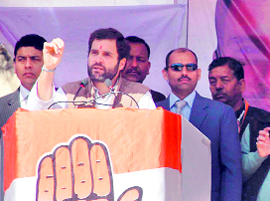
Congress general secretary Rahul Gandhi addresses an election meeting at Pithoragarh on Tuesday
Congress general secretary Rahul Gandhi addresses
 an election meeting at Pithoragarh on Tuesday
Pithoragarh, January 24
Congress general secretary Rahul Gandhi today appealed to the youth to come forward to participate in politics and change the present political system of the state according to the needs of the country.
“The present political parties are in no mood to change the system as they get benefit out of this outdated system. Therefore, the youth is the only hope,” said Rahul Gandhi, addressing an election rally here today.
Rahul Gandhi launched a scathing attack on the BJP Government of the state by blaming it for corrupt practices in the last five years, including misuse of funds released from the Centre for the development of the state.
“During the last five years, BJP did not feel the need of Khanduri, as the government and its leaders were involved in corruption, but the party now needs Khundari as it has to hide corruption before being ousted from the government this time,” said Rahul.
The Congress general secretary said that the Congress was a party of the poor of the country; it belonged to the poor, the backward classes, Dalits and minorities. It was also against corruption as the ministers
involved in corrupt practices have been jailed in Congress rule. “On the other side, the BJP gave shelter to its corrupt ministers in Karnataka, Punjab and in Uttarakhand and has now given shelter to corrupt ministers of Mayawati,” said the Congress general secretary.
“if I share meals with Dalits at their homes, the BJP people object. But if they create the slogan of ‘India shining’ from AC rooms, they think it in positive tone for the country,” said Rahul.
Rahul Gandhi said that it was the Congress which laid the foundation stone of development in Uttarakhand state as the people believed in it just after the state was carved out. “The party not only established industries in the state to give employment to lakhs of youths from the state but has now approved its linking with railway lines. “On the other hand, the BJP is always busy indulging in corrupt practices,” alleged Rahul.
The Congress general secretary elaborated the achievements of the Congress at the Centre and said that it is the party totally devoted to empower the common people by providing security in their basic needs.
“After waiving Rs 60,000 crore loan of poor farmers of the country and empowering them, the party has brought MNREGA, right to education, and would now bring food security Bill to make the poor of the country free from the basic problems of life,” said the Congress general secretary. 

BJP govt failed to use Central funds: Pranab Mukherjee


Dehradun, January 24
Union Finance Minister Pranab Mukherjee today squarely blamed the BJP government in Uttarakhand for failing to use Central funds for the development of the state. He also held the BJP government responsible for instability in the region due to which there had been five Chief Ministers during its seven-year rule in the state.
Pranab told mediapersons in Dehradun that despite huge Central aid, the Uttarakhand government had not been able to spend the funds for the welfare of the people. “A staggering Rs 2,971 crore has been given to the state in the last seven years. Besides, Rs 2,185 crore for human resource development, Rs 1,402 crore for health and family welfare and Rs 1,517 crore for road transport and highways have been provided to the state in the same period,” Mukherjee said, adding that the state government failed to use the funds for the development of the state.
He said the BJP government was not even clear whether it should favour hydroelectric projects or not. “The Uttarakhand Government on the one hand calls for increasing power generation and on the hand it supports those who are protesting against the construction of hydropower projects in the state,” Pranab said, referring to the Pala Maneri project that was scrapped by the Centre after several groups opposed it.
Pranab also asked the BJP to explain what compelled it to change Chief Ministers so many times. “By changing five chief ministers in seven years the BJP has given instability to Uttarakhand,” he said.
The Union minister said the industrial package given to the state could not be extended further as it would lead to regional disparity. “It has been noticed that some industries from the neighbouring regions are shifting to Uttarakhand to avail concessions,” he said. He, however, added that the Centre was committed to industrialisation in Uttarakhand.
On Anna Hazare’s agitation for Jan Lokpal, Pranab said the Congress was committed to ending corruption. He held the Opposition responsible for the non-passage of the Jan Lokpal Bill in Parliament. “We don’t have the majority in the Rajya Sabha and thus cannot be held responsible for the non-passage of the Lokpal Bill. It was the Opposition that changed its stand on the issue,” he added.
Associate in-charge of the Uttarakhand Congress Anees Ahmed and vice-president of the state Congress Suryakant Dhasmana were also present on the occasion.

Uttarakhand awaiting Cong return to power: Girja Vyas

Dehradun, January 24
Former chairperson of the National Commission of Women and senior Congress leader Girja Vyas today said the people of Uttarakhand wanted a change and were anxiously awaiting the return of Congress government in the state.
Addressing a press conference in Dehradun today, Girja Vyas said the sole achievement of the BJP Government in Uttarakhand had been change of chief ministers. She said rampant corruption had taken place in BJP rule in Uttarakhand and revealed that a total of 419 cases of corruption had taken place in the state.
Vyas also took the opportunity to refer to the achievements of the UPA Government at the Centre. She said UPA had worked to weed out corruption in the country and work for the empowerment of women. She reminded Congress was committed to reservation for women and firmly believed that 33 per cent reservation for women in state Assemblies and the Lok Sabha was the best way to ensure women’s empowerment.
She also asserted that Congress will fulfil each and every promise made in its manifesto if it was voted to power in the state. Uttarakhand head of intellectual cell DS Mann and state Congress vice president Suryakant Dhasmana were present at the news conference.

Ex-servicemen’s body to support Congress 

Dehradun, January 24
The Uttarakhand Purv Sainik Avam Ardh Sainik Sangathan has expressed anguish against the BJP government and announced of supporting Congress candidates on most of the seats, barring Harbans Kapoor, BJP candidate for the Cantt seat, Surender Jain of the BJP from Roorkie and Prakash Pant from Pithoragarh.
President of the organisation, Lt-Col Ganga Singh Rawat (retd) extended his support to Lt-General TPS Rawat (retd), president of Uttarakhand Raksha Morcha (URM) Kedar Singh Fonia, rebel BJP leader and now candidate from the URM for Badrinath seat Pushpesh Tripathi, MLA from the Uttarkhand Kranti Dal (P) and Pritam Singh of the UKD (P) for Yamunotri.
He said except these seats, his party would back the Congress on other Assembly constituencies. He, however, said they would oppose Congress candidates in Rajpur and Raipur as well.
The organisation would remain neutral in Rudrprayag and left it on the discretion of ex-servicemen to choose between Independents Luxmi Aggawal and Rakesh Negi from Sahaspur asserting that both candidates were always in touch with people of the area.
Rawat was miffed with the BJP over change of guard, Chief Ministers, in the state government. He also accused the party of indulging in number of scams and plundering the people’s money from exchequer.
He said despite evidence of funds siphoning off in the land grabbing case meant for poor section and village society to the state government, the latter kept mum. He said the state government was equal accomplice in looting the state with the mafia, the bureaucracy and public representatives.
He blamed the government for rendering the Soldier Welfare Ministry and UPNAL spineless.
No action in case of encroachment of land in the name of mother of Rifleman Jaswant Singh, winner of Mahavir Chakra, relentless employment to civilians meant for ex-servicemen and cut down in the health facilities were some of the reasons.