News, Views and Information about NRIs.

A NRI Sabha of Canada's trusted source of News & Views for NRIs around the World.


April 20, 2012

Pakistan plane crashes near Islamabad airport


Map
A plane carrying 127 people has crashed in a residential area near Islamabad international airport.

Aviation officials said the Bhoja Air jet, flight BHO-213, was flying from Karachi to Islamabad when it came down in bad weather minutes from landing.

Emergency teams are at the crash site, in the small village of Hussain Abad.

There are no reports of survivors. Rescue teams have been working in darkness to try to assess if there are any casualties on the ground.

The plane, a Boeing 737 believed to be carrying 121 passengers and six crew, was making its final approach to the airport when the crash happened.

Hafeez Chachar, of the BBC Urdu service, who is near the site of the crash, says seats from the plane are strewn over a wide area.

Reporters say conditions on the ground are difficult because of heavy mud following rain.

Witness Samab Ahmad told the BBC: "I saw the plane crash land and then suddenly catch fire. It crashed on top of some sort of building, which could be residential."

Saifur Rehman, from a police rescue team, told Pakistan's Geo TV: "The wreckage is on fire. The plane is completely destroyed."

A police official at the crash site, Fazle Akbar, told AFP news agency it would be a miracle if there were any survivors.

Relatives of those on board have gathered at Karachi and Islamabad airports awaiting news.

A Bhoja Air official in Karachi said it was making arrangements to fly one member from each family to the capital.

At Islamabad airport, one man yelled "my two daughters are dead", before slumping to the floor in a state of shock.

The uncle of the sisters, aged 18 and 20, said: "We don't even know when or where we will get to see their bodies."

Another woman at the airport was desperately trying to find out if her husband was on the flight.

Zarina Bibi said: "He called me before leaving Karachi but I don't know if he was on this flight or not."

The jet left Karachi at around 17:00 local time (12:00 GMT) and had been due to arrive at 18:50 (13:50 GMT).


There were reports of storms in the area at the time, but it is likely to take investigators weeks to determine the cause of the crash.

There have conflicting reports about the exact numbers of passengers and crew on board.

Bhoja Air is a small new commercial airline which was started about 10 years ago but closed because of financial difficulties. It recently re-opened.

In July 2010, an Airbus A321 crashed as it was about to land in Islamabad, killing all 152 people on board - Pakistan's worst-ever air disaster.

Although Pakistan's air industry has been booming, critics say standards have not always kept pace with the increase in services.

Haroon Rashid, of the BBC Urdu service, said the crash had disrupted flight schedules, with a number of planes bound for Islamabad diverted to Lahore.

April 19, 2012

India tests nuclear-capable missile Agni V enters into ICBM League

HISTORIC DAY: Nation’s most potent missile successfully launched


Agni-5, a long range missile being fired off from a mobile launcher from Wheeler Island, off the east coast of India, in the Indian state of Orissa. India on April 19, 2012 successfully tested a new long-range Agni V missile capable of delivering a one-tonne nuclear warhead anywhere in regional military rival China, and countries outside Asia.

BHUBANESWAR, India — India successfully test-fired on Thursday a nuclear-capable missile that can reach Beijing and Eastern Europe, thrusting the emerging Asian power into an small club of nations with intercontinental nuclear weapons capabilities.
"Today's launch represents another milestone in our quest for our security, preparedness and to explore the frontiers of science," Prime Minister Manmohan Singh said in a congratulatory message to the scientists who developed the rocket.

The Indian-made Agni V is the crowning achievement of a program developed primarily with a threat from neighbouring China in mind.

Only the UN Security Council permanent members - China, France, Russia the United States and Britain - along with Israel, are believed to have such long-range weapons.

Fast emerging as a world economic power, India is keen to play a larger role on the global stage and has long angled for a permanent seat on the Security Council. In recent years it has emerged as the world's top arms importer as it upgrades equipment for a large but outdated military.

"It is one of the ways of signaling India's arrival on the global stage, that India deserves to be sitting at the high table," said Harsh Pant, a defence expert at King's College, London, describing the launch as a "confidence boost".

The launch, which was flagged well in advance, has attracted none of the criticism from the West faced by hermit state North Korea for a failed bid to send up a similar rocket last week.

But Chinese media noted the test with disapproval.

"The West chooses to overlook India's disregard of nuclear and missile control treaties," China's government mouth piece, Global Times tabloid said in an editorial published before the launch, which was delayed by a day because of bad weather.

India has not signed the non-proliferation treaty for nuclear nations, but enjoys a de facto legitimacy for its arsenal, boosted by a landmark 2008 deal with the United States.

On Wednesday, NATO said it did not consider India a threat. The U.S. State Department said India's non-proliferation record was "solid", while urging restraint.

India says its nuclear weapons program is for deterrence only. It is close to completing a nuclear submarine that will increase its ability to launch a counter strike if it were attacked.

India lost a brief Himalayan border war with its larger neighbour, China, in 1962 and has ever since strived to improve its defences. In recent years the government has fretted over China's enhanced military presence near the border.

It is buying more than 100 advanced fighter jets, likely Rafales built by France's Dassault, in one of the largest global arms deals.

Defence Research and Development Organisation (DRDO) chief Vijay Kumar Saraswat said, “Today we have made history. India is now a major missile power. We have done India proud.”
India’s missile scientists had, indeed, made history. Not only had they got the whole nation riveted to TV sets early in the morning but had also fired a shot that was heard across the world. April 19, 2012, will long be remembered in the annals of India’s strategic weapons quest as the day on which India finally came of age in terms of missilery.

With the success of Agni V, Chander told his wildly cheering team, “India had joined the select club of nations with Inter-Continental Ballistic Missile (ICBM) capabilities. Now we have the capability of developing and deploying missiles, anywhere, to any place in the world and at any time.”

Agni V does cover the gaping hole in India’s nuclear deterrent against current military threat scenarios that the country faces, especially from China. In the Agni class of missiles, Agni I with a range of 700 km and Agni II with 2,000 km reach, were meant to deter Pakistan against any nuclear adventure. While Agni III and IV were designed for China, their range limit of 3,000 km was insufficient to strike all key Chinese cities and strategic locations, if the need arose.
Enter Agni V with its now proven range of 5,000 km. Agni’s current configuration can be modified with relative ease to reach longer ranges putting it in the ICBM class of beyond 5,000-km range. Even in its current design, all of China’s strategic and tactical targets within the range of Agni V.
Congratulating the missile team soon after the launch, Prime Minister Manmohan Singh told Saraswat over the phone, “Today’s successful Agni V test launch is another milestone in our quest to add to the credibility of our security and preparedness and to continuously explore the frontiers of science. The entire nation stands together in honouring the achievements of our scientific community that has done the country proud.”
While there is every reason for DRDO’s missile team to feel euphoric, their job on Agni is far from done. The first launch essentially tested the missile configuration.
Agni 5 will be the stepping stone for the next round of capabilities for India. It could be anti-satellite capabilities, launch on demand capabilities, putting small satellites into orbit and multiple and manoeuvrable warheads.
“Most important the future will have intelligent warheads which are able to detect counter measures against them by the enemy and take evasive measures.”

For the Defence Research Development Organisation (DRDO), this would be the 25th launch of the Agni series of missiles and without doubt its most prestigious. With a range of 5,000 km, Agni V would travel a distance of 2,000 km more than any other Indian missile making it the longest range missile currently available in India’s strategic armoury.
It is also the fastest of the missiles, travelling at 24 times the speed of sound or 6,000 metres per second, covering the distance of 5,000 km in just 20 minutes. Agni V’s navigational system is a quantum jump over its cousins, making it the most accurate of the lot. It will soon have an unenviable mobility when it is made ready for what is known as a ‘canister launch’ so that it could be launched from anywhere in India at anytime.
Mission Director Avinash Chander, DRDO’s Chief Controller of R&D (Strategic Missiles Systems), proudly states that it took just three years to bring the missile to the launch-pad from the drawing board. That is an achievement for missiles of this class normally take 8 to 10 years to develop. Tessy Thomas, a senior scientist at the Advance Systems Laboratory (ASL), which puts together Agni, says when they were first tasked with designing Agni V, they were apprehensive. “We had never had a missile cross the equator so this was a first,” she says.
Missiles of the Agni class require mastery over vital technologies that include building powerful light -weight rocket motors, a sophisticated navigation and guidance system and material to withstand the high temperatures experienced during re-entry. For Agni V, the missile team developed two new rocket motors using composite material rather than maraging steel that made the overall missile far lighter. The team saved as much as 40 per cent of the weight, thereby enabling it to add more propellant to power the missile to greater distances.
The team also worked on developing a carbon composite covering for its warhead to withstand the incredibly high temperatures of 6,000 degrees celsius when the missile reenters the atmosphere. As important was vastly improving the navigation and guidance system that despite the tremendously long range piloted the missile to the target and then exploded the payload within minimum error over the Indian Ocean.
VG Sekharan, ASL’s director says, “Agni V was built on the experiences of the others in its class. In doing so, we have taken a quantum leap in technology as Agni V had to go the longest distance, withstand the highest temperatures and go at the fastest velocity that we have ever done before.”
‘No race; it’s counter-threat measure’: India says
Defence Research and Development Organisation (DRDO) chief Vijay Kumar Saraswat said We have no reason to be in a race with any country. Actually it is wrong to talk of a missile race. Everybody will like to have missiles to meet their threat requirements. Just because somebody has got an ICBM that can go up to 10,000 to 12,000 km does not mean that we should have one. India is not in a race with any nation as far as missiles are concerned. India develops missiles only to meet its threat requirements. 
He said when India started the ballistic missile defence (BMD) project, there were only three nations in the world that had such a capability. Today, there are more than six nations that have this capability and more than ten nations are actively involved in developing ballistic missile defence systems. It means if we want to stay in the lead, we will have to add additional features to our existing missiles. Our mission in future will be to make our existing and future missile equipped with additional features like a highly manoeuverable re-entry that will confuse enemy radars and BMDs.
India is now a missile power. It means we are completely self-reliant as far as this technology is concerned. In the eyes of the international community, India can design a missile system for any mission in this field. With this launch, whatever are the demands of our security forces in terms of various targets, geographical zones and other sensitive points, we can meet them all.he concludes.
India’s nonproliferation record solid: US
Washington, April 19
Describing India's non-proliferation record as "solid", the US refused to express any concern on the country's nuclear-capable ICBM launch, which was successfully test fired on Wednesday.

"India is engaged with the international community on non- proliferation issues. And PM Manmohan Singh has attended both of the nuclear security summits, the one in Washington and then Seoul," the State Department spokesperson, Mark Toner, told reporters at his daily news conference.

Agni-V launch: China shows signs of admiration and nervousness

BEIJING: The Chinese foreign ministry suggested Thursday that India's Agni-V launch should not be viewed as an arms race in the way of better relationship between the Himalayan neighbours.

"We are not rivals but cooperative partners. We should cherish the hard-earned momentum of cooperation," Liu Weimin, spokesman of the Chinese foreign ministry said.

The ministry's remarks came as close to expressing admiration for the test-firing of Agni-V as could be expected of a country which comes within the range of the nuclear capable missile. "China and India are both emerging powers," Liu said.

He referred to the meeting between Prime Minister Manmohan Singh and Chinese president Hu Jintao on the sidelines of the recent BRICS meeting in New Delhi saying the "leadership of the two countries agreed to further strengthen cooperation".

The foreign ministry's public views were in sharp contrast to a belligerent commentary published by the Global Times, one of the papers on the stable of the People's Daily, which is owned by the Communist Party of China. The Global Times commentary advised India not to be arrogant about its missile capabilities.

The commentary betrayed signs of nervousness among hawkish sections of the Communist Party of China over India's missile success. But the more moderate People's Daily and a web newspaper published by the State Council under premier Wen Jiabao did not voice an opinion about the Agni V event.

"Even if it (India) has missiles that could reach most parts of China, that does not mean it will gain anything from being arrogant during disputes with China," Global Times said. "India should be clear that China's nuclear power is stronger and more reliable. For the foreseeable future, India would stand no chance in an overall arms race with China".

It also warned India against relying too heavily on its relationship with the United States and the alleged western effort to curb China's growth. The paper carried a graph showing how India's missile capabilities cover several world cities like Moscow, Tehran, Manila, Bangkok, Jakarta and Beijing.

"India should also not overstate the value of its Western allies and the profits it could gain from participating in a containment of China. If it equates long range strategic missiles with deterrence of China, and stirs up further hostility, it could be sorely mistaken," the commentary said.

Speaking at the foreign ministry, Liu said the need of the need of the hour was to "push forward the bilateral strategic and cooperative partnership".

Liu also did not accept a suggestion that the missile launch might affect regional stability. "We hope Asian countries can contribute to regional stability and peace," he said.


April 17, 2012

Space shuttle Discovery makes final landing


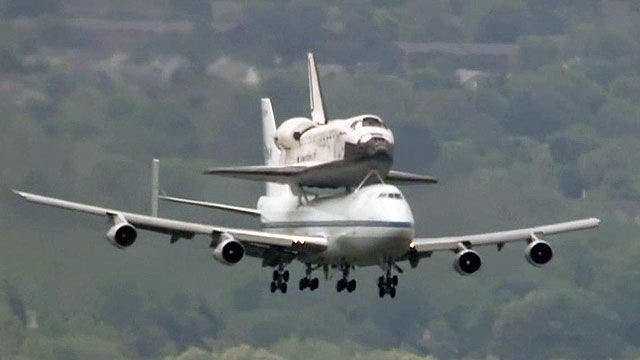
Space shuttle Discovery buzzed metropolitan Washington, D.C., Tuesday morning, soaring over the Washington Monument, the White House and the Capitol before landing to begin its new life as a museum relic -- following three decades of space service for NASA's oldest and most traveled shuttle.
Discovery will be towed Thursday to its installation at the Smithsonian's National Air and Space Museum annex near Dulles in northern Virginia.
Thousands had packed the National Mall in front of the Capitol to watch the pair swoop by, as Discovery took a leisurely spin at an easy-to-spot 1,500 feet (450 meters) overhead. And they took to Twitter, using the tag #spottheshuttle to compare notes.
"Just saw the shuttle fly by. Hoping to see it again on its return into Dulles. Cool moment in history!" wrote one user.
"There are actually no words for how cool that was. Not ashamed to say I cried," another user wrote.
"Look at that -- that thing is mammoth," said Terri Jacobsen. She brought her 12-year-old son to the mall to watch the flyover.
Discovery departed Florida's Kennedy Space Center at daybreak Tuesday aboard a modified jumbo jet bound for Washington, where it will become a Smithsonian exhibit. The shuttle-jet combo is set to land at Dulles International Airport.
Nearly 2,000 people -- former shuttle workers, VIPs, tourists and journalists -- gathered along the old shuttle landing strip earlier in the morning to see Discovery off. A cheer went up as the plane taxied down the runway and soared into a clear sky.
The plane and shuttle headed south and made one last flight over the beaches of Cape Canaveral -- thousands jammed the shore for a glimpse of Discovery -- then returned to the space center in a final salute. Cheers erupted once more as the pair came in low over the runway it had left 20 minutes earlier and finally turned toward the north.
A similar flyover was planned over the monuments in the nation's capital, later in the morning.
Discovery -- the fleet leader with 39 orbital missions -- is the first of the three retired space shuttles to head to a museum. It will go on display at Dulles International Airport in Virginia, taking the place of the shuttle prototype Enterprise. The Enterprise will go to New York City.
Endeavour will head to Los Angeles this fall. Atlantis will remain at Kennedy.
NASA ended the shuttle program last summer after a 30-year run to focus on destinations beyond low-Earth orbit. Private U.S. companies hope to pick up the slack, beginning with space station cargo and then, hopefully, astronauts. The first commercial cargo run, by Space Exploration Technologies Corp., is set to take place in just another few weeks.
For at least the next three to five years -- until commercial passenger craft are available in the United States -- NASA astronauts will have to hitch multimillion-dollar rides on Russian Soyuz capsules to get to the International Space Station.

Colombia scandal 'embarrasses' US Secret Service

Cartagena scandal 'involved 20 women'
The US Secret Service prostitution scandal involved as many as 20 women, 11 American agents and some military personnel, senior US officials say.
Senator Susan Collins, briefed by the Secret Service director, said 20 women were found at the US hotel.
The incidents took place in Cartagena, Colombia, ahead of last weekend's Summit of the Americas.
On Monday, the head of the US armed forces said the Secret Service and the military had "let the boss down".
Secret Service Director Mark Sullivan was "rightly appalled by the agents' actions and is pursuing a vigorous internal investigation", Ms Collins said in a statement.
"He ordered all the agents to return to Washington immediately, and all have been interviewed," said Ms Collins, the top Republican on the Senate's Homeland Security and Governmental Affairs Committee.
Speaking to reporters on Tuesday, Ms Collins, a Republican who represents Maine in the Senate, also said she had asked Mr Sullivan a number of questions during her phone briefing.
"Who were these women? Could they have been members of groups hostile to the United States? Could they have planted bugs, disabled weapons, or... jeopardised [the] security of the president or our country?"
Speaking to reporters afterwards the senator said some agents "were uniformed personnel who are assigned to building security". Others were "these specialised agents who do security details", she said.
Two of the agents were senior personnel with salaries at the top end of the government's pay scale, the Washington Post reported.
All 11 agents have been placed on administrative leave and had their security clearance revoked. They were not directly involved with presidential security.
Also on Tuesday the White House said it had confidence in the director of the Secret Service to investigate the incident, adding that he had addressed the matter quickly.
'Embarrassment'
On Monday a senior official told the BBC that at least 10 military service members were also under investigation, double the five that was originally reported.
General Martin Dempsey said the military did not know exactly what had happened in the Colombian city of Cartagena, a colonial city on the country's Caribbean coast and venue for the Summit of the Americas.
"What we do know is that we distracted the issue from what was a very important regional engagement for our president," he said, adding it was an embarrassment for the agency.
On Sunday, the US president said that he expected a "rigorous" investigation.
"If it turns out that some of the allegations that have been made in the press are confirmed, then of course I'll be angry," Mr Obama said.
Details of what happened on Wednesday night are still coming to light. The group of military and secret service agents were partying at Cartagena's Pley Club, which has been described as a high-end strip club in an industrial part of the port city.
Members of the secret service paid $60 (£38) each to the club's owners to bring at least two women back to the Hotel Caribe, where they were staying, the Washington Post reports.
The next morning one of the women demanded more money and a dispute ensued.
ABC News has said the agents were bragging about their work for the president, telling their company that evening: "We're here to protect him."

Pilot Mistakes Venus for Oncoming Aircraft, Sends Plane into Nosedive


A fatigued and groggy Air Canada co-pilot mistook Venus for an oncoming aircraft and slammed the control stick forward, sending the plane into a momentary dive that injured 16 passengers. The Transportation Safety Board of Canada released a report on Monday about the January 2011 incident that found “sleep inertia” to blame for the co-pilot’s misjudgment.
The flight’s first officer caused the incident after waking up from a nap on the long-haul flight from Toronto to Zurich, Switzerland. His snooze was permitted under a sanctioned procedure known as “controlled rest,” which is said to improve a pilot’s alertness and performance during overnight flights. But while only supposed to sleep for 40 minutes, the first officer dozed off for 75 minutes, sending him into a presumably deep sleep.
The first officer awoke as the captain, who had been controlling the plane, noted an approaching U.S. Air Force jet 1,000 feet below. But groggy and not yet fully alert, the first officer saw a light above the plane and thought it was the Air Force aircraft descending toward them. In reality, it was the planet Venus – though that realization came only after he sent the Boeing 767 into a 400-foot nosedive. “Under the effects of sleep inertia, the first officer perceived the oncoming aircraft to be on a collision course and pushed forward on the control column,” the report notes.
Fourteen passengers and two crew members, none of whom were wearing their seatbelts despite the seatbelt sign being illuminated, were launched out of their seats and hit their heads on the ceiling. Seconds later, they were slammed to the floor as the captain pulled back on the control stick to regain altitude. Many injuries were minor, but when the flight landed safely in Zurich, seven passengers sought medical attention at local hospitals.
But the first officer was unable to sleep off the incident – the investigation lasted more than a year. Air Canada is considering implementing better rest policies for pilots.