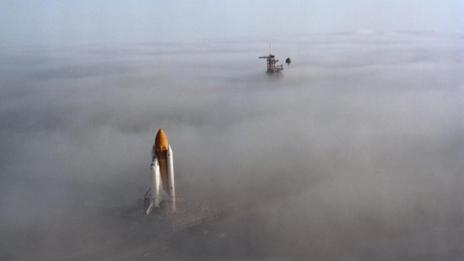
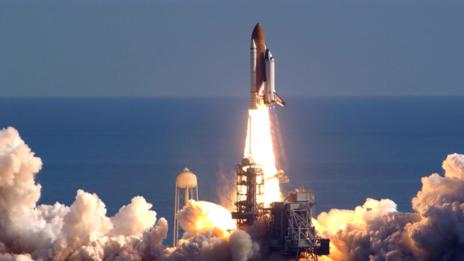
LUBBOCK, TX – Sunday marks the 12th Anniversary of fallen Space Shuttle Columbia mission that killed all seven crew members on board. Pilot William "Willie" McCool's family remembers the tragedy. The space shuttle crashed on it's way back home on February 1, 2003. William McCool's parents, Barry and Audrey McCool, said they remember watching the news and that's when they knew, they had lost their son. “We remember the day every anniversary we think about Willie and we think about the rest of the crew,” Barry McCool said. “And the fact that these are seven heroes that are honored not just by the United States, but they are honored by the world." The Coronado High School graduate dedicated his life NASA Space Program and was the youngest crew member on Columbia. Barry McCool said he wears his son's Naval Astronaut gold wings, instead of his own, in honor of his son's memory. Barry and Audrey McCool said their son's legacy lives on through the McCool Foundation, a scholarship fund to help students pursue a college degree and the Willie McCool Memorial Half Marathon on April 11, 2015.
What caused the Space Shuttle Columbia disaster?
On 1 February 2003, the Space Shuttle Columbia began its descent back to Earth after a 16-day mission. The crew of seven – five men and two women – had carried out some 80 experiments during their time in Earth’s orbit.
Now, they donned their pressure suits and prepared for a return to Earth.
They never made it back.
Their fate had been sealed 16 days before, when the Shuttle lifted off from Cape Canaveral. A piece of foam insulation the size of a briefcase fell off the spacecraft’s external fuel tank, cracking some of the heat-resistant tiles on the Shuttle’s left wing. The crew carried out the subsequent mission unaware their return to Earth was already doomed.
Raining debris
Just before 0900 EST, as the Shuttle re-entered the Earth’s atmosphere 200,000 feet above the United States, Mission Control suddenly lost contact. There was a chilling silence for some 20 minutes before the truth dawned; 38 miles above Texas, the Shuttle had broken apart, and all seven crew were dead.
Nasa then carried out the largest-ever ground search ever undertaken, to try and find pieces of the Shuttle. Pieces were recovered from Texas and the neighbouring states of Louisiana and Arkansas. Only around 40% of the Shuttle has been recovered – the rest remains missing, 12 years later.
But what was recovered was enough to piece together the Shuttle’s final minutes. As the spacecraft descended to Earth, travelling thousands of miles an hour, super-heated atmospheric gases rushed through the breach in the heat-resistant tiles. These tiles were designed to withstand temperatures as high as 1,650C (3,000F) as the spacecraft re-entered the Earth’s atmosphere. Super-heated atmospheric gases forced their way into the Shuttle’s airframe through the hole in the wing, causing the Shuttle to destabilise and then disintegrate.
It turned out that the fateful collision between the insulation foam and the Shuttle had been noticed, but such incidents had occurred before without any cause for concern. But in his personal blog, former flight director Wayne Hale, who was assigned to the ill-fated mission, says that concerns about possible damage to the Thermal Protection System (TPS) had been flagged up.
He says the decision taken by Jon Harpold, the director of mission operations, was that there was no point in telling the crew their concerns, because there was nothing the Columbia’s astronauts could do about it. “He had spent his early career in shuttle entry analysis,” Hale writes. “He knew more about shuttle entry than anybody; the guidance, the navigation, the flight control, the thermal environments and how to control them. After one of the MMTs [Mission Management Teams] when possible damage to the orbiter was discussed, he gave me his opinion: 'You know, there is nothing we can do about damage to the TPS. If it has been damaged it’s probably better not to know. I think the crew would rather not know. Don’t you think it would be better for them to have a happy successful flight and die unexpectedly during entry than to stay on orbit, knowing that there was nothing to be done, until the air ran out?'”
In 2008,a full reviewinto the deaths of the crew ruled that they may have been aware for as long as 41 seconds that they were not in control of the ship. And while nothing could have been done to prevent their deaths – the depressurisation and extreme conditions were too much – the 400-page report suggested future spacecraft should be designed so that, when they do begin to break up in an accident, they experience the "most graceful degradation of vehicle systems and structure to enhance chances for crew survival".
The report was also highly critical of the culture within Nasa that ignored problems with the foam insulation and allowed shortcuts to be taken on other safety issues.
Columbia grounded the remaining Space Shuttle fleet for three years. On 4 July 2006, the space Shuttle Endeavour, one of the three remaining Shuttles, blasted off from Cape Canaveral to complete a successful 13-day mission in space. For the next four years, until the Shuttle fleet bowed out in 2011, the spaceships completed their missions without mishap.
Hong Kong - Hong Kong continued to be the world's freest economy, despite a slight drop in total score from last year due to the decline of perceived level of corruption, the Hong Kong government said on Wednesday.
The 2015 Index of Economic Freedom Report released by the Washington based Heritage Foundation on January 27 (Washington, DC, time), revealed that Hong Kong has been ranked the world's freest economy for 21 consecutive years with an overall score of 89.6 (on a scale from 0 to 100).
Singapore ranked second with 89.4, followed by New Zealand, 82. 1, Australia, 81.5 and Switzerland, 80.5.
Among the 10 Economic Freedom Components measured in the report, Hong Kong continued to come in first in business freedom, trade freedom and financial freedom; second in investment freedom.
Hong Kong's overall score edged down 0.5 points from last year was mainly due to a drop in the ranking in "freedom from corruption" in the index, which, a government spokesman said, was ascribed to high-profile cases that impacted perceptions about corruption in the special administrative region.
In respond to the report, local graft-buster Independent Commission Against Corruption (ICAC) said, extensive media coverage on some of the cases, including the prosecutions and convictions of a former senior government official, may have affected respondents' impression.
Rafael Hui, Hong Kong's former Chief Secretary, and Thomas Kwok, co-chairman of Sun Hung Kai Properties, a local major developer, were found guilty in a corruption case in December.
Yet, the ICAC said, these isolated cases should not be seen as an indicator of deterioration in the probity situation in Hong Kong. According to the 2014 ICAC Annual Survey conducted by an independent research company, only 1.5 percent of respondents had come across corruption in the past 12 months, showing a very low level of corruption.
"We are keenly aware of competition from other economies within and outside the region. We always try to keep up with the latest global economic developments, and strive to enhance our competitiveness," the spokesman said.
The Punjab and Haryana High Court today stayed the implementation of transfer orders of the Enforcement Directorate officer, who had questioned Punjab minister Bikram Majithia in the drugs case. A Division Bench of the High Court also called for the record pertaining to the officer’s transfer.
The Bench of Justice Satish Kumar Mittal and Justice Deepak Sibal fixed February 2 as the next date of hearing. The plea against the transfer has been filed by advocate Navkiran Singh in the drugs case pending adjudication before the High Court. Navkiran Singh, on behalf of the Lawyers for Human Rights International, contended that the transfer at this juncture would hamper investigations into the Rs 6000-crore money-laundering international drug racket. The probe, he said, was at the final stage.
He said ED official Niranjan Singh’s transfer was neither in public interest, nor in the interest of justice. The case was being supervised by the High Court for more than a year and status reports were being filed by state and central agencies.The transfer of an investigating officer, playing an important role in the investigation, was not beyond suspicion.
“In situations where the investigating officers of two important cases, the coal scam and 2G scam, were transferred and the Supreme Court found the same not to be in the interest of justice, it stayed the transfer orders and ordered that the particular investigating officers would remain as investigating officer till the completion of the trial.
“In the present case, since the Enforcement Directorate has interrogated more than 50 important witnesses and the investigation is at fag-end, changing the investigating officer would be sending the investigation directionless…,” he claimed. The father of alleged kingpin in the drugs case Jagdish Singh Bhola has also moved the High Court demanding a probe into the transfer.
What the petitioner said
Lawyers for Human Rights International said ED officer Niranjan Singh’s transfer was neither in public interest, nor in the interest of justice
They said the case was being supervised by the High Court for more than a year and status reports were being filed by state and central agencies
Beijing: Peeved over IMF's forecast that India's growth rate would surpass that of China by 2016, a state-run daily on Wednesday said that having overshadowed by the Communist giant for long, India is seeking evidence to show that "it is not inferior to China".
"It's different in India. Long overshadowed by China, it is keen to become the best in some aspects. It is in dire need of evidence to show that it is not inferior to China," state-run Global Times said in its editorial, a day after IMF forecast that Chinese economy would continue to slowdown even next year and would fall behind India's growth rate.
Besides posting its lowest growth of 7.4 per cent last year in two decades, during which China became the world's second largest economy, it also missed the official target of 7.5 per cent for the first time in recent years, fuelling concerns about a prolonged slowdown.
The IMF report said China's growth rate would further decline to 6.8 this year and 6.3 next year, falling behind India's projected 6.5 per cent growth rate for 2016. Chinese economy however will continue to be big in size as its gross domestic product reached $10.4 trillion this year compared to India's $1.877 trillion in 2013.
"Even if the Indian economy does outstrip China's one day, the impact on the Chinese public will be far less than on its own people, since India has been waiting for the outcome for so long. Some Western media attach more significance to India's overtaking China than Chinese people do," it said.
"When China's GDP growth was above 10 per cent, many voices expounded that such a high rate would be harmful. However, just as China is committed to economic restructuring and a turn to the "new normal," there appears to be more scary predictions for the future. We have to be unswerving in our commitment not to return to the GDP-oriented path," it said.
"GDP figures are so favoured by the media as they are easy to grasp. But China has passed the era of GDP-fixation. Despite continued pursuit of wealth, we highly value safety, environmental protection, equal opportunity and explicit rules. With money, there should also be dignity," it said.
"China's GDP growth is unlikely to always rank top of the global list and we won't modify our set direction in social and economic development," it said. The "new normal" in the Chinese economy doesn't mean stagnation nor recession, but a strategic adjustment toward quality and sustainable development, it said.
"China's growth of seven per cent maintained in the period of economic and social restructuring is no less significant than 10 per cent in the past times of extensive development. While the Chinese government is capable of achieving higher growth, its choice of lowering the rate deserves more praise.
"China has never been applauded by the West in its development since the end of the Cold War. We have grown used to this. We need to stay firm to achieve our target of deepening reform," it said.